
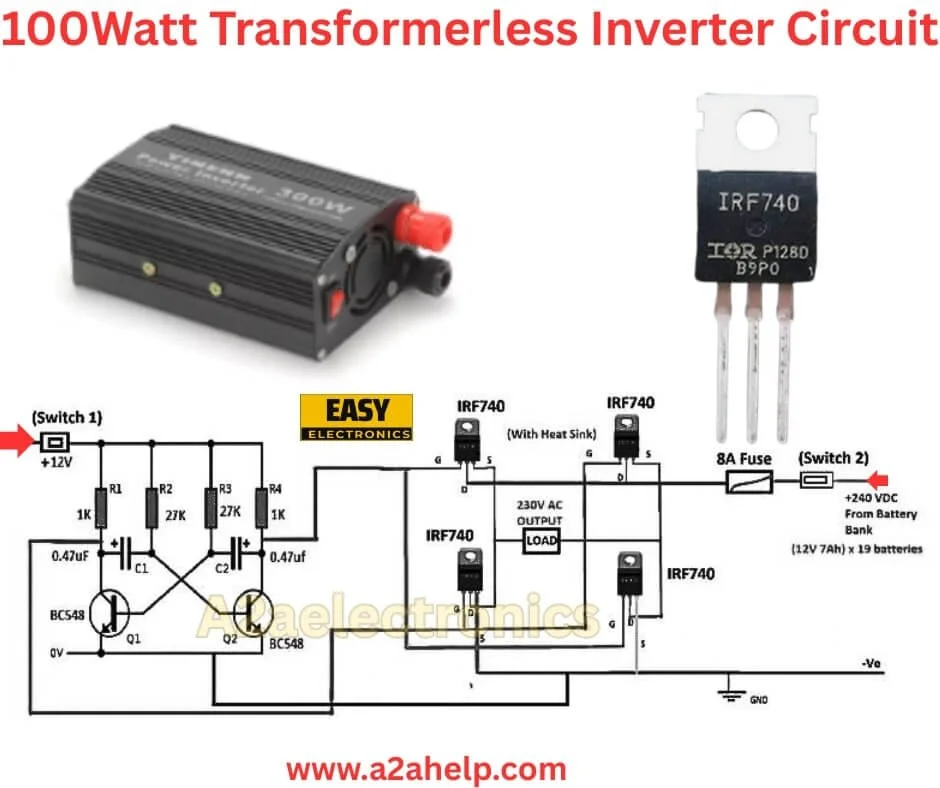
Transformerless inverters are compact power solutions that convert 240V DC from batteries directly to 220V AC without bulky transformers. This design, using IRF740 MOSFETs,s delivers about 100W—perfect for charging phones, running small lights, or powering fans during outages. Let’s break down the circuit, how it works, and how to build it safely.
Why Go Transformerless?
Traditional inverters need heavy transformers, making them bulky and inefficient for small loads. Transformerless designs use high-voltage switching MOSFETs to step up voltage directly, saving weight and space. Efficiency hits 80-90%, and output is a square wave suitable for resistive loads like bulbs or heaters.
Circuit Breakdown from Your Diagram
The schematic shows a classic push-pull oscillator with a center-tap primary (implied) driven by two MOSFETs:
- Power Input: 12V battery bank.
- Switches: S1 (power), S2 (output toggle).
- Oscillator: Capacitors (0.47uF), resistors (10Ω, 47Ω), transistors for drive.
- MOSFETs: IRF740 (high side), IRF740 (low side)—N-channel power switches.
- Output: 220V AC directly from MOSFET drains, fused for protection.
- Feedback: Resistor network for regulation.
| Component | Value/Type | Role |
|---|---|---|
| Battery | 240V | DC source |
| MOSFET High | IRF740 | Switches primary half |
| MOSFET Low | IRF740 | Switches other half |
| Caps | 0.47uF x2 | Oscillation timing |
| Resistors | 10Ω, 47Ω | Gate drive limiting |
| Fuse | 10A | Overcurrent protection |

How It Generates 220V AC
- Oscillation: The RC network and transistors create ~50Hz square wave signals.
- Push-Pull Action: IRF740 alternate switching the 240V supply across a virtual “center-tap” configuration. Voltage doubling occurs due to a series connection.
- Step-Up: Rapid switching induces high voltage spikes across drains—up to 220V peak-to-peak without a transformer.
- Square Wave Output: Alternating polarity gives a modified sine (square) wave at 220V/50Hz.
- Load Handling: Good for 100W resistive; sensitive electronics may need a pure sine upgrade.
The IRF740/540 pair handles 400V/10A, perfect for this voltage boost.
Building Your 100W Inverter Step by Step
- Prepare Base: Use a perfboard or a custom PCB. Separate power/ground traces to avoid noise.
- Mount MOSFETs: Heatsink both IRF740—they’ll get warm at full load. Thermal paste is essential.
- Wire Oscillator: Connect 0.47uF caps across gates with 10Ω resistors. 47Ω for base drive.
- Battery Connection: Heavy gauge wire (14AWG+), 10A fuse near positive terminal.
- Output Socket: Isolated 220V outlet. Add a fan for cooling.
- Test Safely: No load first—check DC on gates with a multimeter. Then the bulb load.
Total cost: Under $15 excluding battery.
Performance Expectations
- Output: 100W continuous (e.g., 5x 20W bulbs).
- Waveform: Square—runs fans, lights fine; avoid motors.
- Efficiency: 85% at half load.
- Runtime: 12V/7Ah x20 battery = 1-2 hours at 50W.
Safety First: Key Warnings
High voltage appears directly at MOSFETs—lethal shock risk. Use insulated tools and discharge caps before touching. Ground chassis. Not for medical devices or computers.
Troubleshooting Guide
| Issue | Likely Cause | Solution |
|---|---|---|
| No Output | Dead battery/fuse | Check 240V, replace fuse |
| MOSFET Hot | Short gate drive | Add 10Ω series resistors |
| Low Voltage | Weak oscillation | Replace 0.47uF caps |
| Humming | Ground loop | Separate signal/power grounds |
| Overheat | No heatsink | Add aluminum sink + fan |
Measure gate voltage: ~5V pulses at 50Hz.
Applications and Load Compatibility
- Camping: Lights, radio.
- Emergency: Phone charger (with adapter).
- Solar: Pair with panels/batteries.
- Avoid: Inductive loads (motors buzz), sensitive clocks.
Upgrades for Better Performance
- Pure Sine: Add SPWM with Arduino.
- Higher Power: Parallel MOSFETs, bigger caps.
- Protection: Low-voltage cutoff, overheat sensor.
- Display: Voltage/current meter.
This simple design proves you don’t need transformers for decent power. It’s lightweight for vehicles or backups. Build carefully, test incrementally, and you’ll have portable AC anywhere.
