
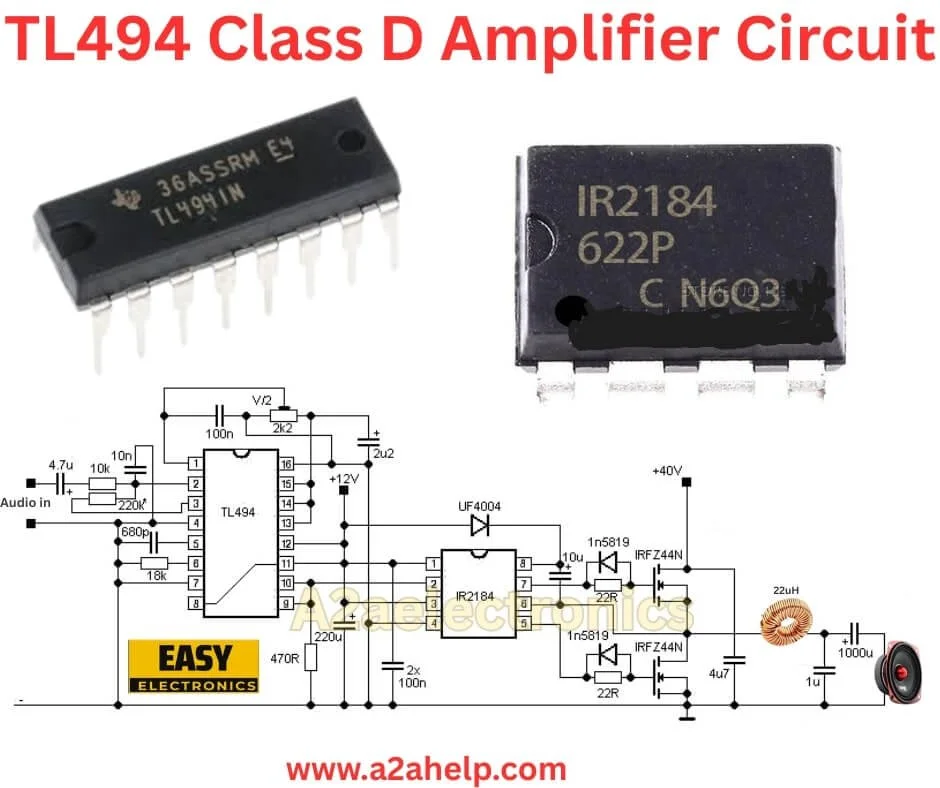
TL494 Class D amplifiers deliver powerful sound with high efficiency, making them ideal for car audio, home systems, and portable setups. This guide breaks down the circuit in your diagram, explains how it works, lists components, and provides build tips to get clean, high-volume audio without wasting power. Let’s dive into this efficient switching design.
What Makes Class D Amplifiers Special?
Class D amps switch power on and off rapidly, rather than using it continuously like traditional amps. This approach achieves 90-95% efficiency, meaning less heat, smaller size, and longer battery life. The TL494 IC, a PWM controller, generates the precise pulses needed for clean audio reproduction.
Circuit Overview and Key Components
Your diagram shows a classic TL494-based Class D setup with MOSFET output stage, gate driver, and LC filter. Here’s what stands out:
- TL494 PWM IC: Generates high-frequency PWM signals by comparing audio input to a sawtooth carrier.
- IR2184 Gate Driver: Boosts PWM signals to drive high-power MOSFETs safely, handling high/low side switching.
- MOSFETs (likely IRFP260N or similar): Power switches (high-side and low-side) that amplify the signal.
- Output LC Filter: Inductor (marked 22uH or similar) and capacitors (C62, 100uF?) reconstruct audio from PWM pulses.
- Power Supply: Typically 30-100V DC for 500W output, with separate bias for TL494 (12V).
- Input Stage: Audio in via coupling caps, pre-amps with TL494 op-amps for gain.
| Component | Typical Value/Model | Role |
|---|---|---|
| PWM IC | TL494 | Generates PWM from audio |
| Gate Driver | IR2184 | Drives MOSFET gates |
| MOSFETs | IRFP260N/IRF540 x2 | Power switching |
| Inductor | 22-35uH | LC low-pass filter |
| Caps | 1000uF/63V x2 | Power filtering |
| Transistors | BD139/BD140 | Bias/driver stage |
How the TL494 Class D Circuit Works
The magic happens in these steps:
- Sawtooth Generator: TL494’s oscillator creates a 50kHz triangle/sawtooth wave via RT/CT pins.
- Comparator: Audio signal modulates the PWM comparator. Louder audio widens pulses; quieter narrows them.
- Gate Driving: IR2184 takes complementary PWM outputs (from TL494 pins 9/10) and drives MOSFETs with dead-time to prevent shoot-through.
- Switching: MOSFETs pulse the supply voltage into a high-frequency square wave at audio frequencies.
- LC Filter: Reconstructs a smooth audio waveform, blocking the carrier frequency. Output to speaker.
- Feedback (optional): Error amps in TL494 stabilize gain and reduce distortion.
Efficiency comes from MOSFETs spending minimal time in linear regions—either fully on (low loss) or off.

Step-by-Step Build Guide
- PCB Layout: Use a double-sided board for clean traces. Keep power and signal grounds separate.
- Power Section: Mount MOSFETs on large heatsinks with thermal paste. Use 50-80V/20A+ supply for 500W.
- Inductor Winding: 22-35uH air-core or ferrite, rated for 10-20A RMS. Measure with an LCR meter.
- Bias Supply: 12V regulator for TL494/IR2184 from the main rail.
- Testing: Start at low voltage (24V). Check PWM at scope, no DC offset at output. Add a scope probe for distortion check.
- Enclosure: Shielded metal case reduces RF interference.
Performance and Efficiency Breakdown
Expect 400-500W RMS into 4-8Ω with <1% THD at full power. Efficiency: 90%+ means cool operation vs. Class AB’s 60%. Frequency response: 20Hz-20kHz, suitable for subwoofers or full-range.
Troubleshooting Common Issues
| Problem | Cause | Fix |
|---|---|---|
| MOSFET Overheat | No dead-time or undersized heatsink | Adjust TL494 dead-time pin; bigger sink/fan |
| Distortion/Noise | Poor grounding or LC mismatch | Separate grounds; tune L=22uH, C=1uF |
| Low Output | Weak bias or bad gate drive | Check 12V supply; test IR2184 bootstrap |
| No PWM | TL494 oscillator fail | Verify RT/CT: 10k/1nF typical |
Oscilloscope traces: PWM duty varies with audio amplitude; post-filter is a clean sine.
Applications for This Amp
- Car subwoofers (compact, efficient).
- Home PA systems.
- DIY portable boomers.
- Guitar/bass rigs needing punch.
Pair with a 24V battery for mobile use—runs cool for hours.
Enhancements to Try
- Add op-amp pre-gain (TL494 as in diagram) for line-level inputs.
- Stereo: Duplicate circuit, share power.
- Protection: Over-current via TL494 sense amp; soft-start.
- Digital: DSP before input for EQ.
This TL494 design punches above its simplicity—proven for high-power DIY audio. Build safely, scope everything, and enjoy bass that shakes the room.
