
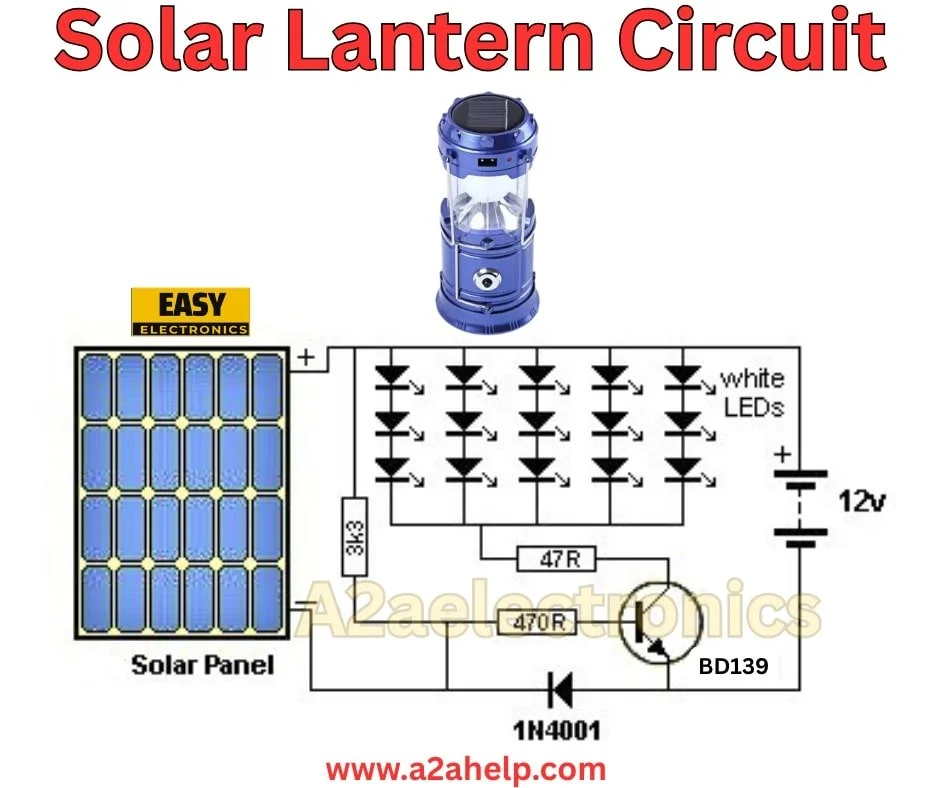
Hey friend, if you have ever wanted a reliable solar lantern that charges during the day, turns on automatically at dusk, and lights up your garden, campsite, or porch without any wiring or batteries to replace, this straightforward circuit is one of the best beginner-friendly designs out there. I have built several of these over the years for friends and family, and they still work perfectly after seasons of outdoor use. It uses a small solar panel to charge a 12V lead-acid battery, a BD139 transistor for dusk sensing, and a string of white LEDs for bright light. No microcontrollers, no complex chargers—just a handful of parts that do the job beautifully. In this guide, I will analyze how it works, list the components, walk you through the build step by step, and share tips to make it last for years. This is a fantastic project for anyone interested in solar energy or off-grid lighting. Let’s get into it.
Why This Solar Lantern Circuit Is So Useful
Solar lanterns are great for areas with unreliable power or for outdoor use where running cables is a hassle. This design stands out because it is automatic: the solar panel charges the battery by day, and a simple light sensor turns the LEDs on when it gets dark. I like it for four main reasons. First, it is dead simple—under ten components. Second, it uses inexpensive parts you can find anywhere. Third, the light is bright enough for practical use with a dozen or more white LEDs. Fourth, it includes basic battery protection and is easy to scale—add more panels or LEDs as needed. I have installed these on patios, in sheds, and even as emergency lights during outages. They charge fully on a sunny day and run all night on a small battery.
Analyzing the Solar Lantern Circuit
The circuit has three main parts: solar charging, automatic switching, and LED lighting. It operates on 12V DC from a sealed lead-acid battery.

Solar Charging Stage
A small solar panel (typically 18V open-circuit, 1–2W) connects directly to the battery through a blocking diode (1N4001). During sunlight, the panel voltage is higher than the battery voltage, so current flows to charge it. The diode prevents reverse current at night when the panel voltage drops. No fancy MPPT or charge controller—just direct charging, which works fine for small lead-acid batteries as they self-regulate.
Dusk-to-Dawn Switching
The clever part is the automatic on/off. A 47kΩ resistor and a 470Ω resistor form a divider from the battery positive. The junction feeds the base of a BD139 NPN transistor through another 47kΩ. When light hits the solar panel, it generates a small voltage that pulls the base high, keeping the transistor off. At dusk, panel voltage drops to near zero, base goes low, the transistor turns on, and current flows to the LEDs.
LED Lighting
A string of white LEDs (typically 12–20 in series/parallel) connects from battery positive through the transistor collector to ground. Each white LED drops about 3.2V, so for 12V you can run 3–4 in series with a current-limiting resistor, or more with parallel strings. The circuit shows multiple LEDs in a matrix for bright output.
The whole thing draws very little quiescent current—under 1mA when off—so the battery lasts ages between charges.
Key Components You Will Need
Everything is cheap and rugged:
- Solar Panel: 12–18V 1–5W polycrystalline (garden light type, $5–10)
- Battery: 12V 1–7Ah sealed lead-acid (motorcycle or alarm battery, $10–20)
- Transistor: BD139 NPN (or BD137, TIP41 for more current, $0.50)
- Diode: 1N4001 or 1N4007 blocking ($0.10)
- Resistors: 47kΩ x2, 470Ω (or adjust for sensitivity, $0.10)
- LEDs: 20–40 white 5mm LEDs (3.2V 20mA, $0.10 each)
- Current Limiting: 10–100Ω resistors per LED string
- Enclosure: Plastic lantern housing or waterproof box ($5)
- Wires, switch (optional manual override), connectors
Total cost: $20–40 for a complete lantern.
Step-by-Step Guide to Building the Solar Lantern
This is beginner-friendly—takes an afternoon.
- Prepare the Panel and Battery: Mount the solar panel on top of your lantern housing, facing south. Connect the panel positive to the diode anode, the cathode to the battery positive.
- Wire the Sensor: From battery positive, 47kΩ to junction, 470Ω to ground. Another 47kΩ from junction to BD139 base.
- Transistor Switching: BD139 emitter to ground, collector to LED negative side.
- LED Array: Arrange LEDs in strings (e.g., 3 LEDs + 100Ω resistor per string, 6–10 strings parallel). Positive to battery +, negative to collector.
- Test Sensitivity: In light, LEDs off. Cover panel—LEDs on. Adjust 47kΩ values if needed (higher for earlier on, lower for later).
- Add Manual Switch: Parallel across the transistor for override.
- Enclose: Seal connections with silicone for outdoor use. Add a reflector or diffuser for better light spread.
- Charge and Test: Leave in the sun one day, enjoy automatic lighting at night.
My first one turned on too early—lowered the 470Ω to 220Ω for better dusk detection.
How the Circuit Performs in Real Use
With a 2W panel and 4Ah battery, it charges fully in 4–6 sunny hours and runs 20 LEDs all night (8–10 hours). Light output is 100–200 lumens—enough for reading or walking. In cloudy weather, it still gets a partial charge. Battery life is years with lead-acid. For brighter, add more LEDs or a 5W panel.
Common Issues and Fixes
- Always On: Panel shaded or bad diode—check voltage.
- Never On: Transistor backwards or resistors wrong.
- Dim Light: Battery low or too many LEDs—add limiting resistors.
- Overcharge: For larger panels, add a 14V zener across the battery.
Safety and Upgrades
Low voltage—safe. Upgrades: add low-battery cutoff, more panels, NiMH batteries, or super-bright LEDs.
Final Thoughts
This solar lantern circuit is simple, reliable, and eco-friendly. Build it for off-grid lighting. More projects on a2ahelp.com.
