
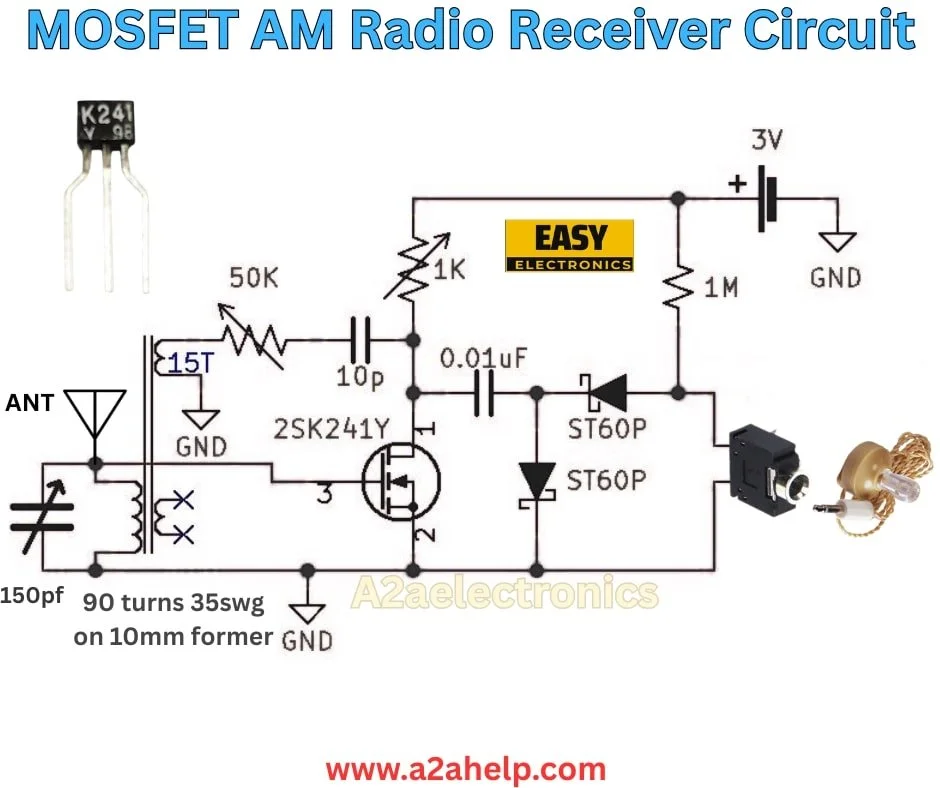
Hey friend, if you have ever wanted to pick up AM radio stations with almost no parts at all, this MOSFET-based receiver is one of the coolest minimal designs out there. I have built several of these over the years. It is a classic single-transistor regenerative detector that works surprisingly well on just 3V. It uses a 2SK241 dual-gate MOSFET as the active device, a hand-wound coil for tuning, and a couple of high-impedance earphones for audio. No ICs, no complicated alignment—just a few components and you are listening to talk radio or news in minutes. In this guide, I will break down how it works, list the exact parts, show you how to build it step by step, and share the tweaks that make it perform even better. This is perfect for beginners learning RF or anyone who loves ultra-simple radios. Let’s get into it.
Why This MOSFET AM Radio Design Is So Appealing
AM medium wave (530–1700 kHz) is full of local stations, and this circuit pulls them in with excellent sensitivity thanks to regeneration. The 2SK241 is a dual-gate N-channel depletion-mode MOSFET originally designed for TV tuners, but it shines in simple radios because of its high input impedance and gain at RF frequencies. I love this design for four main reasons. First, it runs on a single 3V coin cell for weeks. Second, the parts count is tiny—under ten components. Third, tuning is smooth with the variable capacitor and coil. Fourth, the audio is clear in high-impedance earphones, and regeneration gives it that extra boost to hear weak stations. I have used similar setups for emergency radios or just to show friends how radio waves turn into sound with almost nothing.
Breaking Down the MOSFET AM Radio Circuit
The circuit is a regenerative detector: the MOSFET amplifies RF, feeds some back positively to increase gain, and detects the AM signal by slope detection or slight oscillation. It is incredibly simple.

Antenna and Tuning Tank
The antenna (long wire or whip) connects through a small coupling capacitor (not shown, but often 10–100 pF) to the parallel LC tank: 150 pF variable capacitor and the coil (90 turns 35SWG on 10mm former, about 300–400 µH). The tank resonates at the desired station frequency. The 50k pot is the regeneration control, feeding RF from the drain back to gate 2 via a 10 pF capacitor. The 1k resistor limits feedback current.
The Active Device – 2SK241 Dual-Gate MOSFET
The 2SK241 has two gates:
- Gate 1 (G1) connects to the tuned tank for RF input.
- Gate 2 (G2) gets the regeneration feedback and DC bias from the 1M resistor to +3V.
- The source is grounded.
- Drain goes to +3V via the coil primary (15 turns coupled to the main coil—often wound over it).
The MOSFET operates in depletion mode, so no positive gate bias is needed for conduction. Regeneration is controlled by the 50k pot: advance it until you hear a soft rush or plop, then back off slightly for maximum sensitivity without oscillation.
Detection and Audio Output
The detected audio appears at the drain, coupled through 0.01 µF to high-impedance crystal or piezo earphones (32–2000 Ω). Two ST60P germanium diodes (or 1N60) in parallel act as the detector, rectifying the AM envelope. The 1M resistor provides load and bias.
Power Supply
Just 3V from a CR2032 coin cell or two AA cells. Current draw is under 1 mA, so the battery lasts for months.
The beauty is in the regeneration: it boosts Q of the tank dramatically, giving sharp selectivity and high gain for weak signals.
Key Components You Will Need
Everything is cheap and easy to source:
- MOSFET: 2SK241Y (or Russian KP303, 3SK88—any dual-gate depletion N-channel, $2–5)
- Coil: 90 turns 35SWG (0.2 mm) enameled wire on 10mm former (plastic tube or ferrite rod for better sensitivity) + 15 turn regeneration winding over the grounded end
- Variable Capacitor: 150 pF (or 365 pF polyvaricon for full band coverage, $2)
- Pot: 50k linear for regeneration ($0.50)
- Capacitors: 10 pF ceramic (feedback), 0.01 µF ceramic (audio coupling), 150 pF trimmer if fixed
- Resistors: 1k, 1M
- Diodes: 2x ST60P, 1N60, OA91 germanium (silicon works but is less sensitive)
- Earphones: High-impedance crystal or piezo (old telephone earpiece ideal)
- Power: 3V coin cell or battery holder
- Antenna: 1–2 meter wire
Total cost: under $10.
Step-by-Step Guide to Building the MOSFET AM Radio
This is dead-bug or perfboard friendly—takes an hour.
- Wind the Coil: On a 10mm plastic tube or ferrite rod, wind 90 close turns 35SWG, tap at the bottom for ground. Over the bottom 10mm, wind 15 turns for regeneration feedback.
- Mount the 2SK241: Pinout is G1-D-G2-S (check datasheet). Bend leads carefully.
- Wire the Tank: Variable 150 pF across the 90-turn coil. One end to ground, hot end to G1.
- Regeneration: 50k pot from +3V to 10 pF to G2. 1k in series for stability.
- Drain Load: 15-turn winding from drain to +3V.
- Detection: Two germanium diodes, cathode to drain, anode to ground. 0.01 µF from drain to earphones.
- Bias: 1M from +3V to G2.
- Power: +3V to the top of the regen winding, ground everywhere.
- Test: Extend antenna, power on. Slowly advance 50k pot—you should hear a rush. Back off slightly, tune variable cap—stations will pop in loud and clear.
- Box It: Small plastic case with coil outside for portability.
My first one drifted until I used a ferrite rod—much more stable.
How the Circuit Performs in Real Use
With a 1-meter antenna indoors, you pick up strong locals easily. At night, with a long wire, medium wave DX is possible—hundreds of km. Audio is mono and classic AM quality: warm for talk radio, decent for music. Sensitivity rivals cheap portable radios. Battery life is insane—months on a coin cell. Selectivity is sharp thanks to regeneration.
Common Issues and Fixes
- No regeneration: Reverse 15-turn winding polarity or check diodes.
- Only hiss: Antenna too short or coil wrong turns.
- Drifting: Use NPO caps, ferrite rod, or enclose.
- Weak audio: Use proper high-Z earphones or add a one-transistor audio amp.
Safety and Upgrades
Low voltage—totally safe. Upgrades: add a 365 pF variable for full band, a small speaker with a transformer, or a solar cell for power.
Final Thoughts
This MOSFET AM radio is minimalism at its best—one active device pulling stations from thin air. Build it, tune in, enjoy the magic. For simpler radios, check a2ahelp.com.
