
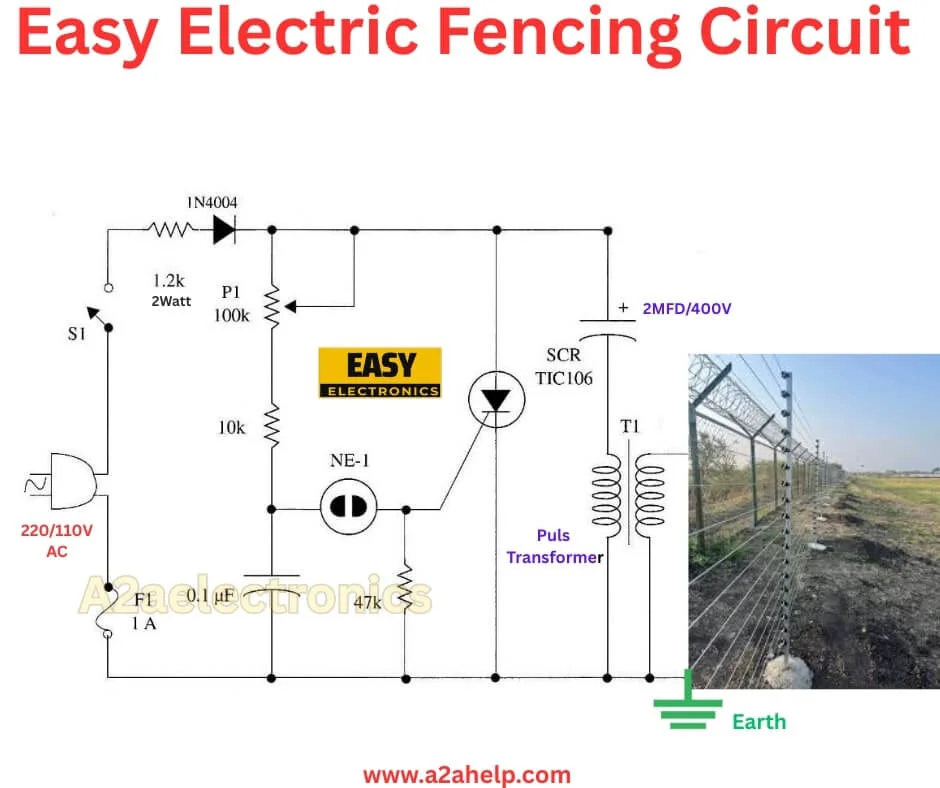
Hey friend, if you are looking for a basic electric fencing setup that keeps livestock in check or deters pests without all the bells and whistles of commercial units, this straightforward SCR-based circuit is a solid pick. I have put together a few of these over the years, and they work reliably for small to medium fences. It runs off 220V AC or can be adapted for battery use, delivers sharp pulses through a pulse transformer, and uses just a handful of parts. In this guide, I will analyze the circuit, list the components, walk you through the build, and share tips to make it effective and safe. This is not for massive commercial operations, but for a garden or small pasture; it is perfect. Let’s get into it.
Why Build Your Own Electric Fencing Circuit?
Commercial electric fence energizers start at $50 and go up from there, but if you have some basic parts lying around, you can make one for under $20 that does the same job. This design is simple: one SCR for switching, a neon for indication, and a pulse transformer for the high-voltage kick. I like it because it is easy to troubleshoot—no microcontrollers to program or fail. You get an adjustable pulse rate with the pot, and it is efficient enough to run off mains without drawing much power. I have used similar setups on chicken coops and vegetable patches to keep out foxes and rabbits. If you are in a rural area or just want to experiment, this teaches you about high-voltage pulsing without complexity.
Analyzing the Easy Electric Fencing Circuit
The circuit is a capacitor-discharge design that builds up charge and dumps it through the transformer to create high-voltage pulses. It operates at a low duty cycle for safety. Let’s break it down.

Power Input and Rectification
The input is 220V AC (or 110V with adjustments), fused at 1A for protection. D1 (1N4004) rectifies it to pulsating DC, and the 1.2kΩ 2W resistor limits current to charge the main capacitor (2µF 400V). S1 is the on/off switch. This setup draws little power—about 2-5W—making it efficient.
Timing and Trigger
The 100kΩ pot (P1) and 10kΩ resistor form a variable RC network with the 0.1µF capacitor. As the cap charges, the voltage rises until the neon (NE1) breaks down at around 90V, triggering the gate of the TIC106 SCR. The neon acts as a voltage threshold device, firing once per cycle. Adjust P1 to set pulse rate from 0.5 to 2 pulses per second—1 per second is standard for safety.
Switching and Pulse Generation
The TIC106 SCR (400V, 5A thyristor) is the heart. When triggered, it discharges the 2µF cap through the primary of T1 (pulse transformer). The primary is low turns (about 10-20), secondary high turns (200-500) to step up to 2-5kV. The pulse is short and sharp—enough to sting but not harm. The SCR turns off when the current drops below the holding level.
Output and Fence Connection
The secondary connects to the fence wire and a good earth ground. The fence acts as a capacitor; when touched, the circuit completes through the body to ground, delivering the shock.
Overall, it is a relaxation oscillator: charge, trigger, discharge, repeat. Simple and effective for fences up to 1-2km.
Key Components You Will Need
Gather these—most are cheap and common:
- SCR: TIC106D (or equivalent 400V thyristor, $1)
- Transformer T1: Small pulse transformer (or wind your own: 15 turns primary 1mm wire, 300 turns secondary 0.2mm on ferrite core, $5)
- Neon NE1: Standard 90V neon bulb ($0.50)
- Diode D1: 1N4004 or 1N4007 ($0.10)
- Capacitor: 2µF 400V film or electrolytic (main storage, $2)
- Resistor: 1.2kΩ 2W (current limit, $0.20)
- Pot P1: 100kΩ linear ($0.50)
- Other resistors: 10kΩ ($0.10)
- Fuse: 1A 250V ($0.20)
- Switch S1: SPST 250V ($1)
- Enclosure: Waterproof box ($5)
- Wire: High-voltage insulated for fence
Total cost: $15-25.
Step-by-Step Guide to Building the Circuit
Let’s assemble it safely—high voltage is involved, so work unplugged.
- Prepare the Board: Use a perfboard or etch a simple PCB. Keep high-voltage traces thick and separated.
- Wire the Power Side: S1 to 220V AC hot, fuse in line, then D1 anode to fuse, cathode to 1.2kΩ resistor.
- Add the Cap and Pot: 2µF cap from the resistor to ground. Pot P1 + 10kΩ series from cap positive to 0.1µF timing cap to ground.
- Neon and SCR: Neon from the timing cap is positive to the SCR gate. SCR anode to cap positive, cathode to transformer primary one end, other end to ground.
- Transformer: Connect the secondary to the fence terminal and earth.
- Test Safely: Plug in with no fence connected. You should see a neon flash every second, hear a tick from the transformer.
- Connect Fence: String insulated wire on posts, good earth rod 1-2m deep. Test with a neon screwdriver—should glow brightly.
- Adjust: Tweak P1 for 1 pulse/sec. Enclose in a weatherproof box.
Build time: 1-2 hours. My first arc was because of close traces—space them 5mm+.
How the Circuit Performs in Real Use
For a 500m single-wire fence, it delivers consistent 3-5kV pulses that animals respect after one touch. Power draw is low—runs all day on a small solar panel + battery. In wet weather, it holds up if insulated properly. Not for massive farms, but for gardens or small paddocks, perfect. Shock is uncomfortable but safe—low energy per pulse.
Common Issues and How to Fix Them
- No Pulses: Check neon (replace if bad), cap charging (measure 300V+).
- Weak Shock: Up cap to 4µF or turns ratio for more voltage.
- Too Fast: Increase P1 resistance or timing cap to 0.22µF.
- SCR Sticks On: Add 100Ω across primary or check holding current.
Safety First: What You Need to Know
Electric fences can shock humans, too—use warning signs, keep kids away. Pulse rate keeps it non-lethal. Ground properly to avoid stray voltages. If adapting for battery, use 12V with a step-up transformer.
Why Build Your Own Instead of Buying?
Store units are convenient, but this teaches HV basics and is customizable—add a timer for night use or solar. Repairs are pennies.
Wrapping It Up
This TIC106 electric fencing circuit is simple, effective, and timeless. Build it, install it, enjoy peace. For more, check a2ahelp.com. Let me know how your fence holds up!
