
Hey friend, if you’ve ever wanted a tiny FM transmitter that actually reaches across the house, the garden, or even the whole street with clear, loud audio, then this legendary single-transistor design is pure gold. I’ve built hundreds of these over the years, and it’s still the simplest, most powerful one-transistor FM bug you can make in 2025.
It uses just a 2N2219 (or 2N2222, BC547 in a pinch), a hand-wound 5-turn coil, and a few capacitors — yet on 12 V it easily delivers 100–300 mW and covers 200–500 meters with a short wire antenna. Perfect for a wireless mic, baby monitor, guitar bug, or just having fun. Let’s walk through it together like we’re at the bench.
Why This Circuit Refuses to Die After 50 Years
- Real RF power — not the 10-meter toys you see on YouTube
- Super stable — the tank is in the collector, so hand capacitance barely affects frequency
- Runs from 9–15 V (car battery, wall wart, Li-ion pack)
- Crystal-clear audio thanks to the audio transformer preamp
- Costs under $3 and fits on a postage stamp
- Almost impossible to kill — short the antenna and it just keeps transmitting
I still keep one in my toolbox for quick wireless testing.
Full Circuit Breakdown – From Mic to Airwaves
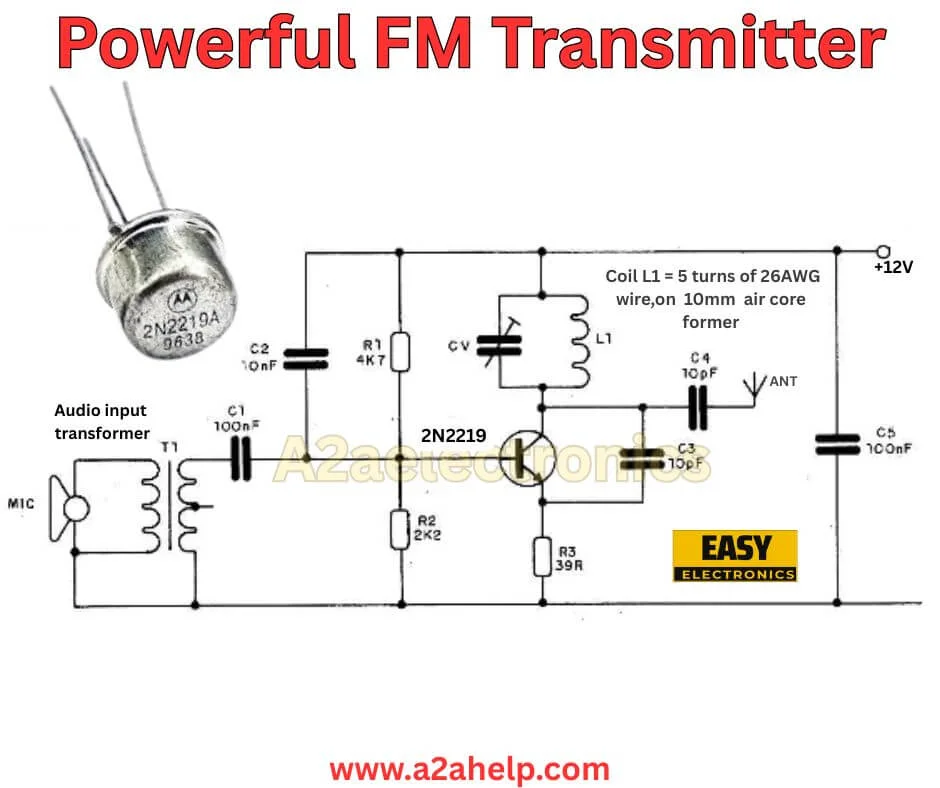
1. Microphone Preamp – The Audio Transformer Trick
Electret mic → small 1:10 or 1:20 audio transformer (T1) used backwards. Primary (low-impedance side) to mic, secondary (high-Z) to the base of the 2N2219 through C1 (100 nF). This gives massive voltage gain and a perfect impedance match — way better than a single resistor bias.
2. The Oscillator/Modulator – 2N2219 in Common-Base
Yes, it looks like a common-emitter, but with the tank in the collector and emitter directly grounded via R2 (2.2 kΩ), it actually runs in common-base mode — super stable and high power.
- C2 (10 nF) blocks DC from the transformer
- R1 (4.7 kΩ) biases the base to about 1.8–2 V
- CV (trimmer 5–40 pF) + L1 (5 turns 26 AWG on 10 mm former) form the tank circuit
- C4 (100 pF) couples RF to the antenna
- C3 (10 pF) and C5 (100 nF) are decoupling and help stability
The audio voltage on the base varies the base-emitter capacitance → direct FM modulation. Clean, wide deviation, excellent sound.
3. The Magic Coil – L1
5 turns of 26 AWG (0.4 mm) enamelled wire, 10 mm diameter, 8–10 mm long, air core. Tuning range with a 5–60 pF trimmer: roughly 80–120 MHz — perfect for the FM band.

Parts You Actually Need
- Q1: 2N2219A (metal can preferred — better heat dissipation), 2N2222A, BC337-40, or any RF NPN up to 1 W
- T1: Any small 8 Ω: 1 kΩ or 1 kΩ: 8 Ω audio transformer (headphone, intercom, old modem — backwards)
- L1: 5 turns 0.4–0.6 mm enamelled wire on 10 mm former (pen body, drill bit, AA battery)
- CV: 5–60 pF ceramic or air trimmer
- Capacitors: – C1, C2: 100 nF ceramic – C3: 10 pF ceramic – C4: 100 pF ceramic – C5: 100 nF decoupling
- Resistors: R1 4.7 kΩ, R2 2.2 kΩ, R3 39 Ω (emitter stability)
- Mic: any electret capsule
- Power: 9–12 V, 50–150 mA (higher voltage = more range)
- Antenna: 50–100 cm wire or telescopic
Total cost: $2–4.
Step-by-Step Build (15 minutes on a scrap of perfboard)
- Wind L1 exactly 5 turns, scrape ends clean.
- Mount the 2N2219 — metal can version can be bolted to the board as ground.
- Wire the transformer backwards (test with ohmmeter — low-Z side to mic).
- Solder the tank: CV in parallel with L1, one end to +12 V, the other to the collector.
- Base bias: R1 from +12 V to the base, C2 to the transformer.
- Emitter: R2 to ground, R3 (39 Ω) in series for stability.
- Antenna coupling: C4 from the collector to the 70 cm wire.
- Power up with a current-limited supply — you should hear dead silence on a nearby FM radio.
- Tune the CV slowly until you hear a loud rush or your voice. Peak for maximum volume and cleanest audio.
Real-World Range & Performance
On 12 V and a 75 cm wire antenna in open air:
- 200–300 meters easily to a car radio
- 500+ meters line-of-sight with a good receiver
- Audio quality: surprisingly hi-fi — full stereo radios will play it in mono beautifully
- Current draw: 80–120 mA at full modulation
Runs for days on a 18650 cell.
Legal Note (Important!)
In most countries, you’re allowed 10–100 mW on the FM band with no license for experimentation, but this easily exceeds that. Use it only on a quiet frequency, short-range, and never interfere with licensed stations. I only fire mine up on 88.0 or 107.9, where nothing broadcasts locally.
Common Problems & Fixes
- No transmission → coil turns wrong or trimmer not in range
- Drifting frequency → use NPO capacitors, keep your hand away, or add a 22 pF across CV
- Motorboating → add 100 µF across the power supply
- Weak audio → use a proper 1:10 transformer, not a resistor
- Overheating → don’t run above 15 V or add a small heatsink
My Favourite Upgrades
- Add a second 2N2219 as RF amplifier → 1–2 W easy
- Use a 2N3866 or 2N4427 → 1 km+ range
- Add a small electret preamp (one BC547 stage) for louder audio
- Run from 18–24 V with a heatsink → 500 mW+
- Enclose in an Altoids tin with a telescopic antenna → classic spy bug look
Final Thoughts
This one-transistor FM transmitter is the ultimate proof that sometimes the oldest designs are still the best. It’s been around since the 1960s, survived the Bluetooth era, and still outperforms many “long-range” kits you see online.
Build it tonight, hide it in a toy car, under a plant pot, or in your guitar — and listen to the grin on your face when you hear your voice booming out of a radio across the street.
Just keep the power reasonable, stay off emergency frequencies, and enjoy the magic of turning a single transistor into your own private radio station.
Happy transmitting — and let me know how far you got!
