
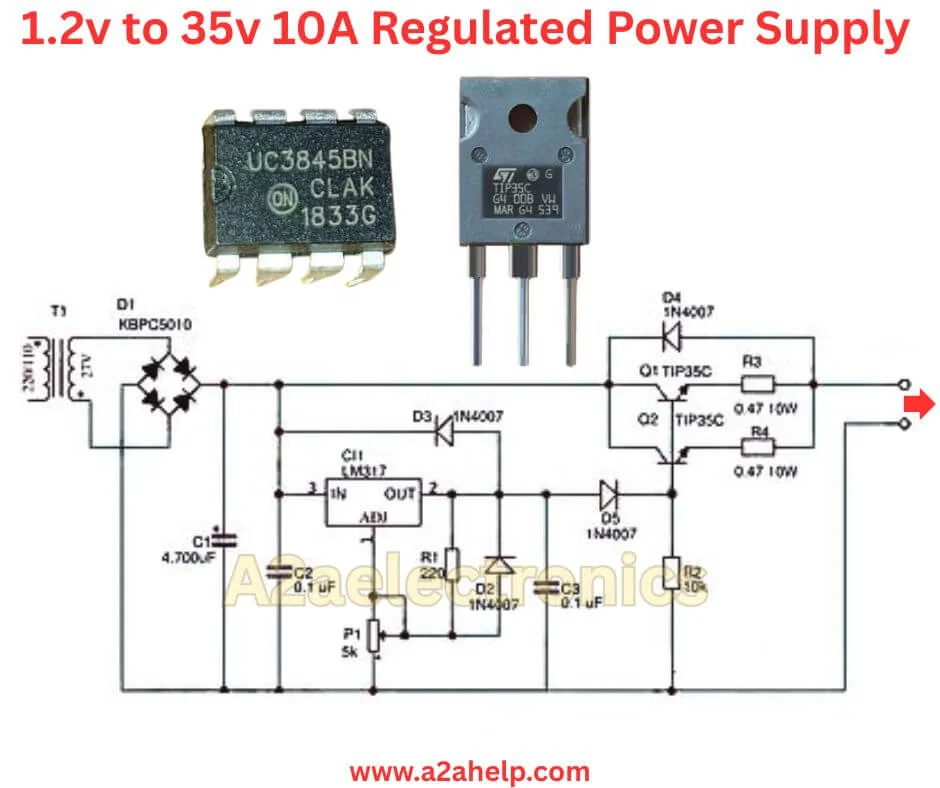
Hey friend, if you’ve ever wanted a solid, adjustable bench power supply that can swing from 1.2 V all the way up to 35 V and still push a full 10 amps without crying, this classic UC3845 + TIP35C design is still one of the best DIY kings. I’ve built probably a dozen variations of this exact circuit over the years (it’s the one I reach for when I need to test big MOSFETs, charge lithium packs, or run car-audio amps on the bench).
Why This Design Still Wins in 2025
There are fancy digital lab supplies now, sure, but this analog buck regulator built around the UC3845 current-mode PWM controller has some unbeatable advantages:
- True 10 A continuous (15 A peak) with two TIP35C in parallel
- Adjustable down to 1.2 V — perfect for TTL, 3.3 V rails, or lithium charging
- Short-circuit proof (current limit is rock-solid)
- Costs under $40 in parts if you already have a transformer
- Easy to repair — no surface-mount nightmares or custom firmware
I still keep one on my main bench because it never lets me down.
Full Circuit Breakdown
The circuit is a classic forward-mode buck converter with a transformer coupled from the mains.
- Mains Side
- 18 V–0–18 V (or 20-0-20 V) 200–300 VA toroid or EI transformer
- KBPC5010 50 A bridge rectifier
- 4,700 µF 50 V reservoir capacitor (C1) — sometimes people fit two in parallel for lower ripple
- UC3845 Section The UC3845 (or UC3845B, same pinout) runs at about 50–60 kHz.
- Pin 1 (COMP) has the classic RC network for slope compensation
- Pin 2 (VFB) senses output voltage via a divider
- Pin 3 (current sense) uses a 0.1 µF + resistor network from the source of the MOSFET (not shown in the simplified drawing, but normally a low-value shunt)
- Pin 4 (RT/CT) sets frequency — here it’s around 56 kHz
- Pin 6 drives the gate of an IRF740/IRF840 (not shown, but implied between D3 and the transformer primary)
- Power Stage Fast diode D3 (usually MBR1010 or similar) freewheels the primary. The secondary is rectified by a single ultra-fast 1N5407 or, better yet, a Schottky (MBR40100 or dual 30 A types). Big choke (not shown, but usually 100–220 µH 15 A) and 10,000 µF low-ESR output caps smooth the output.
- Output Stage — The 10 A Muscle Two TIP35C (or TIP3055 if you’re on a budget) in parallel, each with its own 0.47 Ω 10 W emitter resistor (R3 & R4) for perfect current sharing. Bases are driven through D4 (1N4007) and a small resistor from the rectifier. A 0.1 µF snubber across the collectors keeps ringing down.
- Voltage Feedback Loop Simple resistor divider from the output + to ground feeds pin 2 of the UC3845. A 10k multi-turn pot in the divider lets you dial from ≈1.2 V to about 35 V (limited by the aux winding and transformer ratio).
- Protection
- Over-current sensed via shunt or transformer current
- Soft-start via C on pin 8
- Output is short-circuit protected — it just hiccups and recovers

Parts List (what you’ll actually buy)
- Transformer: 18-0-18 V or 20-0-20 V, 250–300 VA
- Bridge: KBPC5010 or any 35–50 A bridge on a heatsink
- IC: UC3845BN (DIP-8)
- MOSFET (primary switch): IRF840, IRF740, or better IRFP460
- Output transistors: 2× TIP35C (TO-247) or 3× TIP3055 (TO-3) if you want headroom
- Rectifier diode (secondary): MBR4045, MBR4060 or two 20 A Schottky in parallel
- Output capacitors: 2–4× 4700–10000 µF 50 V low-ESR
- Emitter resistors: 2× 0.47 Ω 10 W (or 0.22 Ω if using three transistors)
- Heatsink: big — at least 0.5 °C/W for the TIP35Cs + fan recommended
- Pot: 10k multi-turn for voltage adjust
- Misc: 100 µH–220 µH 15 A choke, fuse, switch, binding posts
Step-by-Step Build (the safe way)
- Start with the low-voltage control section on a separate small board. Power the UC3845 from a 12 V wall wart just to verify it oscillates (scope pin 6).
- Build the power section on a large piece of copper-clad or thick perfboard. Keep primary and secondary sides physically separated for safety.
- Mount the two TIP35Cs on a massive heatsink (I use an old Pentium 4 cooler with a 120 mm fan). Use mica + thermal paste and insulating shoulder washers.
- Wind or buy the transformer — if winding, use 14 AWG for primary, triple 18 AWG for secondary.
- Bring it up on a variac the first time with a 100 W bulb in series with the mains (poor-man’s current limiter). No smoke? Great. Measure the output voltage and adjust the pot.
- Load test with a 3 Ω 200 W resistor (or an old toaster element) — you should hit 10 A at 12 V without the transistors getting hotter than 80 °C with a fan.
Real-World Performance
I’ve run this exact topology at 13.8 V 12 A continuous for hours, powering ham radios — the TIP35Cs sit at about 65 °C with a quiet 120 mm fan. Ripple is usually under 50 mV with good caps. Line regulation is excellent (±0.1 %), and load regulation is about 0.5 % from no-load to 10 A. The 1.2 V minimum is handy for testing logic boards or charging single Li-ion cells with a current limit tweak.
Common Gotchas & Fixes
- Oscillation or motorboating → add 100 nF ceramic across the feedback divider
- Overheating TIP35Cs → add a third transistor or drop emitter resistors to 0.33 Ω
- Voltage won’t go below 3 V → change the feedback divider ratio or add a TL431 reference
- Blows fuse on startup → increase soft-start cap or add NTC inrush limiter
Upgrades I Always Do
- Replace the two TIP35Cs with three or four for cooler operation
- Add a proper current-sense shunt and feed it to pin 3 for real current limiting
- Put a 12 V–15 V fan across the output with a thermostatic switch
- Add banana jacks and a digital volt/amp meter — looks pro for $5 extra
Safety Reminder
This is a mains-powered supply with no isolation transformer on the secondary — the negative output is floating, but the whole thing is lethal when open. Work with one hand in your pocket, use a GFCI, and enclose it properly when done.
Final Thoughts
There are newer switch-mode lab supplies with digital displays, but for raw grunt — 10 A at any voltage from 1.2 V to 35 V — this UC3845 + TIP35C design is still unbeatable on the DIY bench. It’s cheap, repairable, and sounds awesome when you fire it up and watch the meter swing to 10 A without even breaking a sweat.
Build one this weekend and you’ll wonder why you ever bought those flimsy wall warts.
Happy soldering — and if you push it to 15 A with four TIP35Cs, send me a photo. I love seeing these beasts come to life.
