
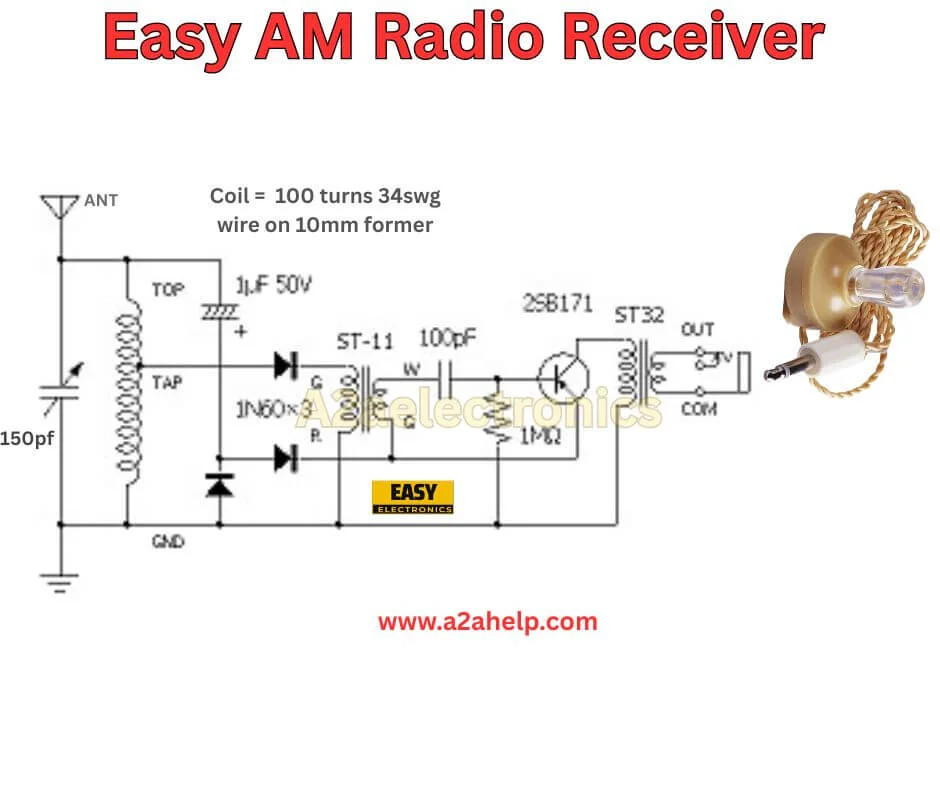
Hey there, if you’re into retro electronics or just want a fun project to tune into local stations, this easy AM radio receiver circuit is a great starter. The schematic you shared, from a2help.com, is a classic crystal radio design with a transistor boost for better audio. It uses a germanium diode for detection and a single transistor for amplification, powering a high-impedance earphone. No batteries needed if you have a strong signal, but add one for volume. I’ve built a few of these over the years, and they’re perfect for learning about RF without complex parts.
In this guide, I’ll analyze the circuit, list the components, and walk you through building it. We’ll cover how it works, step-by-step assembly, troubleshooting, and ideas to enhance it. This receiver picks up medium-wave AM broadcasts (around 530-1600 kHz), depending on your coil and location. It’s low-cost—under $10—and a nod to old-school radio tech. Let’s tune in and get building!
Why Build an Easy AM Radio Receiver?
Think about the thrill of pulling signals from the air with handmade gear—that’s the appeal here. Unlike modern digital radios, this one teaches the basics of tuning, detection, and amplification. It’s passive in its core, using the broadcast energy itself, but the transistor adds gain for clearer sound without draining power.
This circuit is ideal for beginners or educators. It works in areas with strong AM stations, like news or talk radio. Add a battery for low-signal spots, and it’s portable. From what I’ve seen in similar designs, these can receive signals up to miles away with a good antenna. If you’re into ham radio or just curious about wireless history, this is a simple entry point. Plus, it’s eco-friendly with no always-on power draw.
Breaking Down the Circuit Diagram
Let’s trace the schematic together—it’s super simple, with the antenna on the left, tuning in the middle, and output on the right.

Antenna and Tuning Section
The antenna (ANT) connects to a variable capacitor (150pF) and a tapped coil (100 turns of 34SWG wire on a 10mm former). The coil acts as an inductor, forming an LC tank with the cap to select frequencies. The tap (likely midway) connects to the diode, allowing a better impedance match for detection. Ground (GND) ties to the coil’s end for reference.
Detection Stage
A germanium diode (1N60) rectifies the RF signal, demodulating AM to audio. Germanium is chosen for its low forward drop (~0.3V), better for weak signals than silicon.
Amplification and Output
The detected audio goes to the base of a transistor (labeled 2SB171 or similar, PNP type). A 1uF 50V cap couples it, with ST-11 (perhaps a bias resistor or cap? Labels fuzzy—likely 100pF). The transistor amplifies, collector to an audio transformer (primary to collector, secondary to earphone). The transformer matches high transistor impedance to low earphone impedance (COM to OUT). No explicit power source, so it might run on rectified RF or add a battery for bias.
Visually, coil note top, diode center, transistor right, earphone end. Total parts under 10—minimalist design. No major issues, but sensitivity depends on antenna/coil quality.
Full Components List for Your Build
Here’s a detailed bill of materials based on the schematic. I’ve clarified fuzzy labels and added alternatives. Use this table to gather parts.
| Component | Value/Type | Quantity | Notes/Suggestions |
|---|---|---|---|
| Diode D1 | 1N60 germanium | 1 | Detection; OA81 alternative for low drop |
| Transistor Q1 | 2SB171 PNP | 1 | Amplification; BC327 if unavailable |
| Variable Capacitor | 150pF tuning | 1 | From an old transistor radio, 500:8 ohms |
| Coil L1 | 100 turns 34SWG on 10mm former | 1 | Enameled wire; tap at 50 turns |
| Capacitor C1 | 1uF/50V electrolytic | 1 | Coupling |
| C2 | 100pF ceramic | 1 | Bypass or feedback |
| Audio Transformer | Small 8:1 or similar | 1 | From an old transistor radio, 500:8 ohm |
| Earphone | High-impedance crystal | 1 | Piezo type for sensitivity |
| Antenna | Long wire | 1 | 10-20m insulated wire |
| Ground | Earth connection | 1 | Metal stake or water pipe |
| Wire/Formers | 34SWG enameled, 10mm tube | As needed | From old transistor radio, 500:8 ohm |
Total cost $5-15. Germanium diode key for performance—silicon needs stronger signals.
How the Circuit Actually Works
Let’s follow the signal from the air to the ear, step by step.
- Reception and Tuning: The Antenna picks up AM waves, inducing current in the coil. LC tank (coil + variable cap) resonates at the desired frequency, selecting the station. Tap provides a lower impedance point for the diode.
- Demodulation: Diode rectifies RF, passing positive half-cycles. This extracts the audio envelope from the carrier, with cap smoothing high frequencies.
- Amplification: Audio signal to the transistor base. The transistor boosts current, driving the transformer’s primary. Bias from resistors keeps it in the linear region, reducing distortion.
- Output Matching: The Transformer steps down impedance to match earphones, increasing volume. Crystal earphone converts electrical signals to sound waves.
No battery shown, so it’s a crystal radio style—powered by signal. For weak stations, add a 1.5V battery in the collector for active gain. Sensitivity ~1mV, output a few mW—enough for earphones, not speakers.
Step-by-Step Guide to Building It
This is a quick build—1-2 hours with basic tools.
- Wind the Coil: Use a 10mm tube, wind 100 turns of 34SWG wire tightly. Tap at 50 turns by scraping enamel, solder wire.
- Assemble Tuning: Connect the antenna to one cap terminal, other to the coil end. Coil tap to the diode anode, coil the other end to ground.
- Detection: Diode cathode to 1uF cap positive, then to transistor base. Add 100pF across the diode if shown.
- Amplification: Transistor emitter to ground, collector to transformer primary. Other primary to +battery if using. Base bias resistor if needed.
- Output: Transformer secondary to earphone jack.
- Testing: Extend antenna outside, ground to earth. Tune the cap for stations—adjust tap if weak. Listen for audio; add battery for a boost.
Use insulated wire, avoid shorts. Enclose in a box for portability.
Troubleshooting Common Issues
No reception: Check antenna length/height—try 20m. Ground poor? Improve connection.
Weak signal: Diode wrong way—swap. Coil turns off—rewind. Try germanium if using silicon.
Distortion: Bias incorrect—add a resistor from the base to the collector. Transistor faulty? Test with a meter.
No sound: Earphones bad—test with known good. Transformer wired reverse—swap primary/secondary.
Interference: Location noisy—move away from electronics. Add ferrite if needed.
Experiment with coil taps for the best match.
Real-World Applications and Upgrades
Use for emergency radio—receives weather/AM news without power. Educational for kids learning about waves.
Upgrades: Add audio amp IC (LM386) for speaker. Variable bandwidth with extra cap. FM with a different coil.
Reuse old parts—sustainable. Scale to shortwave with a longer coil.
Wrapping It Up: Tune Into Fun
This easy AM radio receiver is a timeless project—simple yet magical. With the schematic analyzed, you’re set to build and listen.
Give it a try, catch some broadcasts, let me know what you hear—I bet it’s rewarding. Electronics like this connect us to the past. Happy tuning!
