
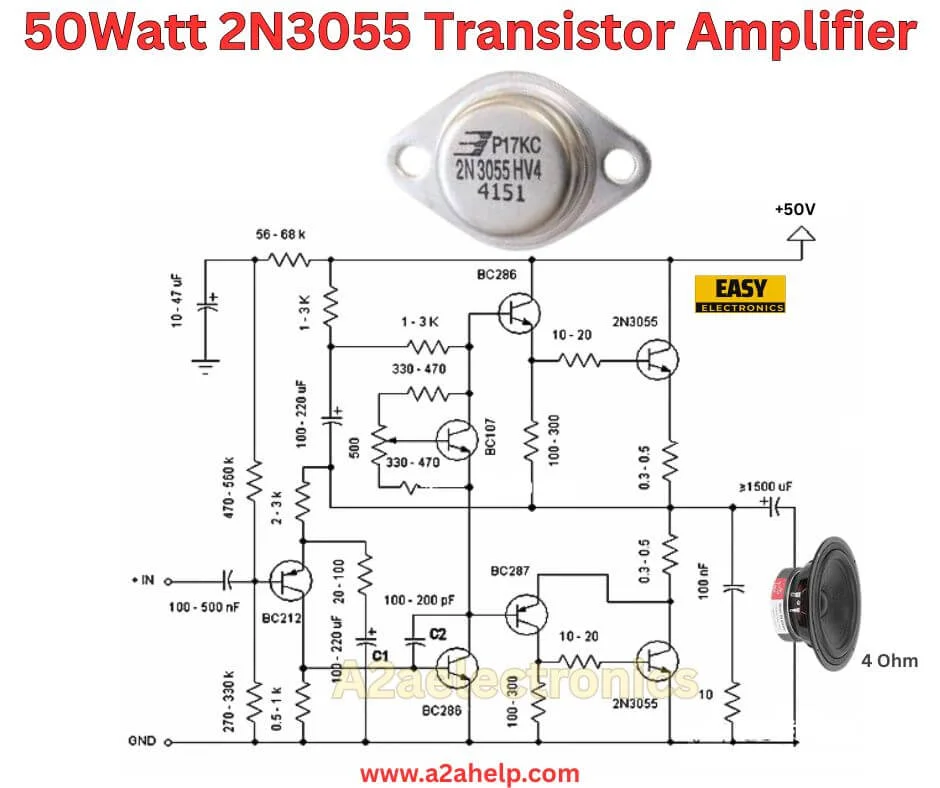
Hey buddy, if you enjoy audio projects as much as I do, this 50W amplifier circuit with 2N3055 transistors is a classic worth trying. The schematic you shared, likely from a2help.com, is a straightforward class AB design that uses a few bipolar transistors to boost an audio signal for a 4-ohm speaker. It runs on a single +50V supply and delivers decent power for home setups or small events. I’ve built similar amps back in the day, and they offer a warm sound with simple parts—perfect for beginners stepping up from basic IC designs.
In this guide, I’ll analyze the circuit, list all the components, and explain how to put it together. We’ll cover the workings, assembly steps, troubleshooting, and some ideas to improve it. This amp isn’t hi-fi by modern standards, but it’s reliable and teaches a lot about transistor biasing and power stages. Grab your soldering iron, and let’s see how to make music louder!
Why Choose a 50W Amplifier with 2N3055 Transistors?
You might ask why go with this when chips like TDA7294 exist. Well, the 2N3055 is a rugged NPN power transistor that’s been around since the 1960s—cheap, easy to find, and handles 15A at 60V. This circuit uses a pair in the output stage for push-pull operation, giving 50W into 4 ohms with low distortion for its era.
It’s ideal for DIY enthusiasts wanting to learn discrete electronics. The single supply simplifies the power setup—no need for symmetric rails like in some amps. Efficiency is around 50%, so expect heat, but that’s manageable with heatsinks. For guitar practice, PA speakers, or even car audio with a boost converter, it fits well. If you’re scavenging parts from old gear, 2N3055s are common finds. Overall, it’s a fun build that sounds good without complexity.
Breaking Down the Circuit Diagram
Let’s examine the schematic closely, as if we’re testing it on the bench. It’s a multi-stage amp with input on the left, driver in the middle, and output on the right, powered by +50V.

Input Stage
The audio input connects to a 100-500nF cap to block DC, then to the base of BC212 (PNP transistor) via a 1k resistor. This stage provides initial gain, with a 270-330 ohm emitter resistor and 100-200pF cap for stability. A 56-68k collector resistor pulls from +50V, and biasing comes from a network including 470k and 1.3k resistors.
Driver Stage
The signal from BC212 collector goes to BC207 (NPN) base through a 20-30 ohm resistor. BC207 drives the next stage, with emitter to ground via 100 ohms and collector to +50V via 500-1k ohms. Feedback or biasing involves 330-470 ohms and caps like 100-200pF. A BC286 (PNP) helps in the driver, perhaps as a current booster.
Output Stage
The power comes from two 2N3055 NPN transistors in a Darlington or quasi-complementary configuration. One 2N3055 base connects to the driver, emitter to a 0.5-1 ohm resistor, and collector to +50V. The other handles the lower side, with diodes or resistors for biasing to avoid crossover distortion. Output couples through a 1500uF cap to the 4 ohm speaker, with a 0.3-0.5 ohm series resistor for stability.
Power and Feedback
+50V rail has 10-47uF decoupling caps. Global feedback from output back to input via a 3.3k-10k resistor reduces distortion. The design uses bootstrapping with caps to improve swing.
Visually, 2N3055 photo top, circuit linear flow. It’s a single-channel amp—duplicate for stereo. No major safety issues, but add a fuse on the supply.
Full Components List for Your Build
Here’s a complete bill of materials pulled from the schematic. I’ve estimated some values where labels are fuzzy and added notes for sourcing.
| Component | Value/Type | Quantity | Notes/Suggestions |
|---|---|---|---|
| Transistors: Q1, Q2 | 2N3055 NPN | 2 | Power output; TO-3 package, heatsink essential |
| Q3 | BC286 PNP | 1 | Driver stage |
| Q4 | BC207 NPN | 1 | Pre-driver |
| Q5 | BC212 PNP | 1 | Input stage |
| Q6 | BC286 PNP | 1 | Bias or driver |
| Capacitors: C1 | 100-200pF ceramic | 1 | Feedback |
| C2 | 220uF/50V electrolytic | 1 | Bootstrap |
| C3 | 10-47uF/50V electrolytic | 1 | Decoupling |
| C4 | 100-500nF ceramic | 1 | Input coupling |
| C5 | 1500uF/50V electrolytic | 1 | Output coupling |
| C6 | 100-200pF ceramic | 1 | Stability |
| Resistors: R1 | 56-68k ohm, 1/4W | 1 | Collector load |
| R2 | 1-3k ohm, 1/4W | 1 | Bias |
| R3 | 330-470 ohm, 1W | 1 | Emitter |
| R4 | 100-200 ohm, 1/4W | 1 | Driver |
| R5 | 500-1k ohm, 1/4W | 1 | Load |
| R6 | 0.3-0.5 ohm, 5W wirewound | 1 | Output stabilizer |
| R7 | 10-20 ohm, 1/4W | 1 | Base |
| R8 | 100 ohm, 1/4W | 1 | Emitter |
| R9 | 270-330 ohm, 1/4W | 1 | Input |
| R10 | 1k ohm, 1/4W | 1 | Feedback |
| Heatsink | Large aluminum | 2 | For 2N3055s |
| PCB/Perfboard | Vero board | 1 | For assembly |
| Speaker | 4 ohm, 50W+ | 1 | Test load |
| Power Supply | +50V DC, 2A+ | 1 | Regulated transformer/rectifier |
Total cost $10-20. 2N3055 pinout: Base, emitter, collector (case).
How the Circuit Actually Works
Let’s trace the signal path.
- Input Amplification: Audio enters the BC212 base, amplified as a common emitter. Gain set by collector/emitter resistors ~50. Bias keeps it linear.
- Driver Stage: Signal to BC207 base, further amplified. BC286 boosts current, driving output transistors without overload.
- Output Push-Pull: Upper 2N3055 sources current for the positive half, lower sinks for the negative. Quasi-complementary uses NPNs with diodes for symmetry. Output swing nearly rail-to-rail minus drops.
- Feedback and Stability: A Feedback resistor from output to input reduces gain but lowers distortion/ impedance. Caps prevent oscillation.
- Power Delivery: At 50W, current ~3.5A RMS into 4 ohms. Quiescent ~50mA. THD ~1% at full power.
Single supply, DC-coupled internal, AC-coupled output. Heat from output transistors ~25W max.
Step-by-Step Guide to Building It
Start with a clean workspace—2-4 hours.
- Board Layout: Perfboard 4×6 inches. Mount 2N3055s on heatsinks off-board.
- Input Section: Solder BC212, input cap/resistor. Add a bias network.
- Driver: Connect BC207/BC286, resistors/caps per schema.
- Output: Wire 2N3055s—bases to driver, emitters to 0.5 ohm then output cap.
- Power Connections: +50V to collectors/bias, ground everywhere. Decouple with caps.
- Testing: Power with limited supply. Check bias voltages (~0.6V drops). Input tone—measure output wave, adjust bias for low crossover.
Avoid shorts. Use scope for distortion.
Troubleshooting Common Issues
No sound: Check supply (+50V), transistor pins. Dead BC212? Swap.
Distortion: Bias off—adjust resistors for 10-20mA quiescent.
Overheat: High bias—measure emitter current. Fan heatsinks.
Hum: Ground loop—single point ground. Bigger supply cap.
Oscillation: Add base stoppers (10 ohms). Bypass caps close to transistors.
Meter checks DC, scope AC.
Real-World Applications and Upgrades
Home audio, guitar amp (add preamp). Portable with a battery.
Upgrades: Stereo duplicate. Current limit with the sense resistor. Tone controls.
Scavenge parts—sustainable. Scale to 100W with parallel 2N3055s.
Wrapping It Up: Classic Power for Your Audio
This 50W 2N3055 amp is timeless—simple yet effective. With the schematic analyzed, you’re ready to build.
Try it, play your tunes, let me know the sound—I think you’ll like it. Electronics fun like this never gets old!
